Publishers Hiring AI Engineers—What Authors Must Know
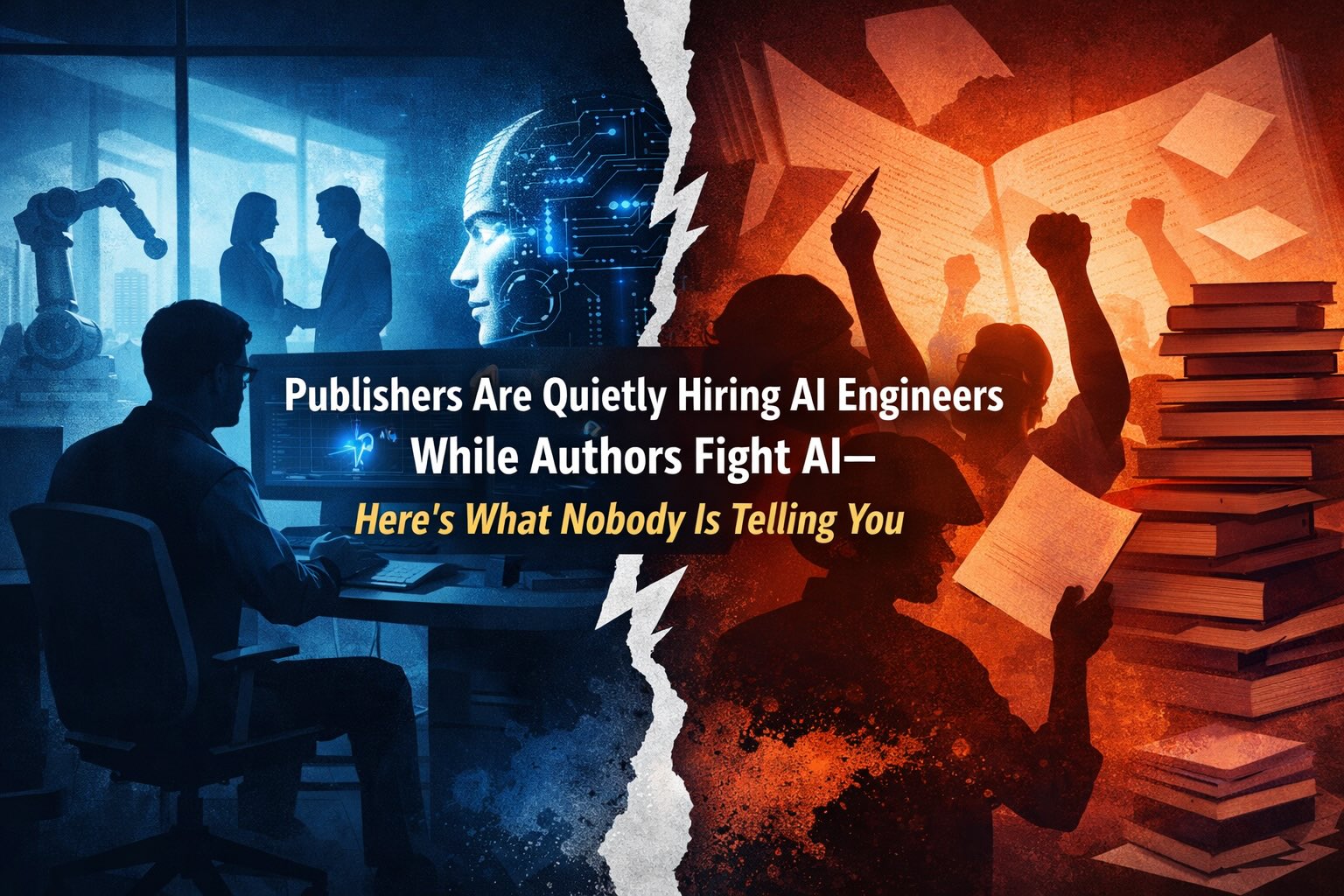
A recent Forbes investigation revealed something that should make every author pay attention: Penguin Random House, Macmillan, Sourcebooks, and Wiley are actively hiring AI engineers. Not for writing books. Not for editing manuscripts. For something far more important to your book's success—marketing and discovery.
While authors file lawsuits and prominent writers like Margaret Atwood call AI "a crap poet," publishers are quietly building the exact AI infrastructure that will determine which books succeed in an increasingly crowded marketplace.
And here's the uncomfortable truth from someone who works in this space: We already know publishers are using AI tools like ours behind the scenes. Many of their authors have no idea.
Quick Answer: Major publishers are hiring AI engineers to build forecasting models, optimize book marketing, improve discovery, and increase efficiency—not to replace writers. Authors who resist all AI while publishers embrace it for marketing create a dangerous competitive disadvantage, especially for indie authors who could access the same tools without gatekeepers.
What You'll Learn
- What Publishers Are Actually Using AI For
- The Uncomfortable Truth About the AI Divide
- Why Authors Are Fighting the Wrong Battle
- The Indie Author Advantage
- What You Should Do Instead
- FAQ
What Publishers Are Actually Using AI For
According to the Forbes report and public job listings reviewed, here's what publishers are building:
Penguin Random House
The world's largest trade publisher is hiring a Senior AI Solutions Engineer to develop AI systems for:
- Book marketing and discovery
- Inventory management (deciding how many copies to print)
- Operational excellence across the organization
In January 2025, their parent company Bertelsmann rolled out ChatGPT Enterprise to employees company-wide.
Pan Macmillan
Hiring two AI "solutions managers" for:
- Identifying AI use cases for "complex business challenges"
- Building prototypes and new workflows
- Keyword tagging to make books more discoverable
- Document summarization and translation
- Content moderation
Their blog post is clear: "We are a publisher of human stories, by human writers"—but they're using AI for everything around the writing.
Wiley
Perhaps most telling: Wiley booked $40 million in fiscal year 2025 just from AI licensing deals, selling backlist titles and academic books to companies like Anthropic.
What they're NOT using AI for: Writing. Editing. Replacing human creativity.
What they ARE using AI for: The exact things that determine whether your book succeeds—marketing, positioning, discovery, and audience targeting. The pattern is now extending to acquisitions tooling as well: in January 2026 Trilogy launched Manuscript AI specifically for slush-pile triage at the publisher tier, with Storywise and Familiar already in paid use at small and mid-sized houses. We covered the full vendor landscape and what's actually shipped in Manuscript AI for Trade Publisher Acquisitions.
The Uncomfortable Truth About the AI Divide
Here's what we know from working with over 2,000 authors and publishers:
Publishers are already using AI marketing tools. Some work directly with services like ManuscriptReport. Some build internal versions of the same technology. But they're using it.
Most of their authors don't know. While writers protest AI on social media and file lawsuits, their publishers are quietly building AI infrastructure to make smarter decisions about which books to push, how to price them, and who to market them to.
As publishing expert Jane Friedman told Forbes: "It does, I think, put publishers in a very awkward position because they have to pay attention to the fact that this technology isn't going anywhere. They've got shareholders who are probably asking, 'How are you going to use this to make money, create efficiencies, et cetera?'"
The $40 Million Question
When Wiley can generate $40 million from AI licensing deals in a single year, that's not a company experimenting. That's a company that has already decided where the industry is going.
Subscribe & Get Your Free Marketing Plan Template
Receive regular updates on marketing best-practices, AI shortcuts, and get our proven 4-phase marketing roadmap for free.
Publishing technology consultant Thad McIlroy put it bluntly: "Publishers are recognizing that this is a tool that's going to make them more efficient, it's going to allow them to do more work with less labor, and you're going to make them sell more books. And so they're faced with the dilemma of how many tools do they incorporate before word gets out."
Before word gets out.
Well, word is out now.
Why Authors Are Fighting the Wrong Battle
Let's be clear about something: The copyright concerns are legitimate. Authors absolutely deserve to be compensated when their work trains AI models. The lawsuits against companies that scraped pirated books from shadow libraries were justified (Anthropic settled for $1.5 billion).
But here's where authors are losing the plot:
The Writing vs Marketing Divide
Authors are fighting against AI for writing—something publishers aren't even doing. Meanwhile, publishers are racing ahead with AI for marketing—the thing that actually makes or breaks a book's success.
You can have the most beautifully written novel in the world. If nobody discovers it, if it's priced wrong, if it's marketed to the wrong audience, if the cover copy doesn't connect—it doesn't matter.
Publishers know this. That's why they're hiring AI engineers for marketing, not writing.
The Amazon Kindle "Chat" Controversy
When Amazon added an AI feature to Kindle allowing readers to "chat" with books (asking about plot details, character names, analysis), the Authors Guild and writers erupted in fury.
But here's what they missed: Amazon explicitly stated the feature doesn't train on book content—it's "a natural language expansion of the search functionality that already exists in Kindle."
The outrage focused on whether AI "read" the books. Nobody asked: "Could this feature help readers discover and engage with my book more deeply? Could it drive more word-of-mouth recommendations?"
What Margaret Atwood Got Wrong
Margaret Atwood called AI "a crap poet" and a "data scrapper." She's not wrong about AI-generated poetry. But she's fighting yesterday's battle.
The real question isn't whether AI can write like Margaret Atwood (it can't). The question is: Can AI help more readers discover books like The Handmaid's Tale? Can it generate the 47 pieces of marketing copy needed to launch a book successfully?
And the answer is yes—which is why publishers are investing millions in it.
The Indie Author Advantage: Access Without Gatekeepers
Here's where this story gets interesting for indie authors:
Everything publishers are building internally, you can access right now.
You don't need to wait for Penguin Random House to greenlight your manuscript. You don't need Macmillan's internal AI tools. You don't need a $100,000 marketing budget.
What ManuscriptReport Does (That Publishers Are Building)
Based on our work with 2,000+ authors—including authors from traditional publishers—here's what the same AI technology provides:
- Market positioning analysis - The AI equivalent of what Penguin Random House uses for "book marketing and discovery"
- Comp title research - What Macmillan's "keyword tagging" system identifies
- Audience targeting - The forecasting models publishers use to predict performance
- Marketing copy at scale - Back cover blurbs, ad copy, social posts, press releases
Traditional authors wait for their publisher to run this analysis (if they do it at all). Indie authors can do it themselves in hours, not months.
The Level Playing Field
For the first time in publishing history, indie authors have access to the same intelligence that major publishers use—without the gatekeepers, without giving up rights, without waiting for approval.
While traditional authors debate whether their publisher should use AI, indie authors are already using it to:
- Launch smarter (better positioning, clearer audience targeting)
- Market faster (17 marketing assets in one report vs months of back-and-forth)
- Compete harder (professional-grade marketing materials at indie budgets)
What You Should Do Instead of Resisting AI
1. Understand the Distinction
AI for writing: Controversial, often produces mediocre results, threatens the craft AI for marketing: Industry standard, produces competitive advantages, enhances the business
Fight to protect your copyright. But don't sabotage your marketing strategy because you conflate the two.
2. Focus on What Actually Sells Books
According to our data from 2,000+ author reports:
- 83% of authors struggle most with marketing, not writing
- The average book launch requires 15-20 different marketing assets (blurbs, ad copy, social posts, keywords, etc.)
- Traditional publishers provide 3-5 of these assets—leaving authors to figure out the rest
If your publisher is using AI to optimize your book's marketing, positioning, and discovery—shouldn't you know how those systems work?
3. Maintain Your Competitive Edge
Publishing technology consultant Thad McIlroy noted that publishers face "the dilemma of how many tools do they incorporate before word gets out."
Word is out. Now you face a choice:
- Option A: Resist all AI on principle while your competition (and your own publisher) uses it strategically
- Option B: Learn which AI tools enhance your marketing without compromising your creative integrity
4. Protect Your Copyright, Use AI Responsibly
You can simultaneously:
- Support lawsuits against AI companies that trained on pirated books
- Demand compensation when your work trains AI models
- Use AI tools that don't train on copyrighted books (like ManuscriptReport, which deletes all data within 30 days)
These positions aren't contradictory. They're smart business.
Your Book Marketing Toolkit
Essential Resources:
- Alliance of Independent Authors (ALLi) - Industry advocacy and best practices → allianceindependentauthors.org
- Amazon Kindle Direct Publishing (KDP) - Self-publishing platform and marketing tools → Wikipedia: Kindle Direct Publishing
- ManuscriptReport - AI-powered book marketing reports (doesn't train on your book, deletes data within 30 days) → Get your book marketing report
Frequently Asked Questions
Are publishers really using AI without telling authors?
Yes. According to the Forbes investigation and public job listings, major publishers like Penguin Random House, Macmillan, and others are actively hiring AI engineers and building internal AI systems. These tools focus on marketing, discovery, inventory management, and operational efficiency—not writing or editing. While publishers are transparent in job postings, most haven't publicized these initiatives to avoid backlash from the author community.
Should authors be worried about publishers using AI?
Not if the AI is used appropriately. Publishers are using AI for the same things marketing teams have always done—just more efficiently. The concern should be if publishers use AI to replace human editorial judgment or creative decisions. For marketing, discovery, and operational tasks, AI makes publishers more competitive, which benefits authors through better positioning and reach.
Is using AI for book marketing the same as using AI to write books?
No. Using AI to write your book means outsourcing creative work to a machine—producing generic, often low-quality content. Using AI for book marketing means analyzing your completed manuscript to generate marketing assets (blurbs, keywords, ad copy, audience profiles) based on what's already in your book. Publishers distinguish between these two uses, which is why they're hiring AI engineers for marketing, not writing.
Can indie authors access the same AI tools publishers are building?
Yes. Services like ManuscriptReport provide the same AI-powered marketing analysis that publishers are developing internally—comp title research, audience targeting, positioning analysis, and marketing copy generation. The difference is indie authors can access these tools immediately without gatekeepers, while traditional authors wait for their publisher to run the analysis (if they do it at all).
What's the difference between AI companies training on copyrighted books vs. using AI for book marketing?
Training on copyrighted books means an AI company feeds your book (often pirated) into their model to teach it to generate text—without your permission or compensation. This is what the lawsuits address. Using AI for book marketing means analyzing your specific book to generate marketing recommendations and copy—you control the input, you own the output, and your book isn't used to train anything. ManuscriptReport, for example, deletes all manuscript data within 30 days and never uses books for training.
Won't using AI for marketing make my book sound generic?
Only if you use it wrong. AI-generated marketing materials are a starting point, not a finished product. Publishers use AI to generate options, then human marketers refine them based on brand voice, audience insight, and strategic positioning. The same approach works for authors—use AI to overcome the blank page and generate 10 variations of your back cover blurb, then edit the best one to match your voice.
How can I tell if my publisher is using AI to market my book?
Ask them directly. Most publishers won't volunteer this information to avoid controversy, but if you ask specific questions ("Are you using AI for keyword research? For comp title analysis? For predicting print runs?"), you'll likely get honest answers. Publishers using AI for operational tasks aren't doing anything unethical—they're using available tools to compete more effectively.
What should traditionally published authors do with this information?
Understand that your publisher may be using AI tools for marketing and positioning—which means you should also understand how these systems work. If you're responsible for any aspect of your own marketing (which most traditionally published authors are), consider how AI tools can help you create professional-grade materials that complement your publisher's efforts. Knowledge is power, and the power imbalance only grows if you resist learning about tools your publisher already uses.
The Real Question Isn't Whether to Use AI
The Forbes investigation exposed what insiders already knew: major publishers are investing heavily in AI infrastructure for marketing, discovery, and operational efficiency.
The question isn't whether AI will be part of book publishing. Publishers with billions in revenue and shareholders demanding efficiency have already answered that question.
The real questions are:
- Will you understand how these tools work, or remain in the dark while others optimize?
- Will you distinguish between AI that threatens creative work vs. AI that enhances marketing?
- Will you leverage the same tools publishers use, or create an artificial disadvantage?
George R.R. Martin called AI "the world's most expensive and energy-intensive plagiarism machine" when fighting copyright violations. He's right about that battle. But while he fights AI companies in court, his publisher is likely using AI to market his books more effectively.
The irony is thick. And the competitive advantage goes to those who can hold both truths simultaneously: fight for copyright protection and use AI strategically for marketing.
Ready to access the same AI-powered book marketing intelligence publishers are building? ManuscriptReport provides comprehensive marketing analysis without training on your book or compromising your copyright. Get your book marketing report here.
Related Reading:
- AI Book Marketing: The Complete Guide for Authors in 2026
- How to Write a Book Blurb That Actually Sells
Source: This article references reporting from Forbes staff writer Rashi Shrivastava, published February 3, 2026. Read the original investigation: "Why Some Of The Largest Book Publishers Are Hiring AI Engineers"
Turn your manuscript into a ready-to-market package
ManuscriptReport turns your full book into 20 launch-ready marketing assets — back-cover blurb, SEO keywords, comp titles, ad copy, and more.
Get Your Marketing Report →Enjoyed this article? Subscribe for more + get a free marketing roadmap template.
Receive regular updates on marketing best-practices, AI shortcuts, and get our proven 4-phase marketing roadmap template for free.