Manuscript AI for Trade Publisher Acquisitions: 2026 Playbook

In 2026, trade publishers use AI at the acquisitions stage for three specific tasks: first-read triage on submissions, verification (not generation) of comp titles in query letters, and market-fit scoring against backlist performance. Purpose-built tools — Trilogy Manuscript AI, Storywise, Familiar — launched in 2025–2026 for high-volume slush triage. General-purpose LLMs (ChatGPT, Claude) remain unreliable for comp-title work due to documented hallucination and stale-data failure modes. The integration that's working pairs AI for first-draft analysis with human editorial judgment for the acquisition decision.
The clearest evidence that pre-acquisition AI detection isn't yet operational at Big Five scale is the Shy Girl cancellation. Hachette's Wildfire imprint canceled debut novelist Mia Ballard's Shy Girl in March 2026 after Reddit-driven analysis flagged AI-pattern text post-publication. The book had launched in the UK in November 2025; Ballard claimed a freelance editor had added AI text without her knowledge. Trade-publisher intake processes didn't catch it. Readers did.
Jane Friedman's February 2025 industry snapshot called AI in publisher submissions "lots of experimenting but no implementation yet." Fifteen months later that framing is no longer accurate: at least one major institutional product launched in January 2026, paid adoption is documented at small and mid-sized publishers, and the trade-publishing press has named the workflow patterns. The Clarkesworld and Asimov's magazine-slush AI flood of 2023 was the leading indicator; trade acquisitions is now the late-arriving market.
What You'll Learn
- The Slush Pile Already Has an AI Problem
- What "No Implementation Yet" Meant in February 2025
- Manuscript AI Tools That Shipped in 2026
- How AI Plugs Into an Editor's Day
- Manuscript Analysis with General LLMs: Why ChatGPT Fails for Comp Titles
- Where ManuscriptReport Fits at the Acquisition Stage
- Agent Contracts, Author Disclosure, and AI in the Loop
- Frequently Asked Questions
The Slush Pile Already Has an AI Problem
Most coverage of AI in publishing acquisitions starts from the publisher side: should we adopt AI to read submissions faster? But the more pressing question for acquisitions editors in 2026 is whether the slush pile they're reading is already AI-generated — and whether the workflow leak inside their own house is bigger than the vendor decision they haven't made yet.
The leading indicator was short fiction. Clarkesworld's submissions snapshot tracks the inflection point: from under 25 AI-related rejections per month through most of 2022, the magazine logged about 50 in December 2022, around 120 in January 2023, and more than 500 in the first three weeks of February 2023 — at which point editor Neil Clarke closed submissions entirely. Roughly 500 of the 1,200 submissions received that month were machine-generated, traced primarily to YouTube and TikTok videos selling AI-submission strategies as passive income. The Magazine of Fantasy & Science Fiction temporarily closed submissions in July 2023 citing AI volume. Sheila Williams, editor of Asimov's Science Fiction, addressed it directly in a January/February 2024 editorial. Asimov's guidelines now warn that AI-generated submissions can result in permanent ban.
Trade publishing's structural exposure looks different — most Big Five and large indie imprints are agent-mediated, so unsolicited slush is filtered upstream by agencies — but the same pressure exists one layer up. Literary agencies receiving query letters in 2026 are seeing AI-generated queries, AI-generated synopses, and AI-fabricated comp titles. The agencies absorbing the volume are then forwarding their shortlist to trade editors who have no way to know whether the manuscript in front of them passed through ChatGPT at any point in its development.
The Authors Guild's April 2026 statement on publisher AI use named the actual operational problem precisely: current AI use "stems from individual time pressures rather than official publisher directives." In plain language — agents and editors are privately uploading manuscripts to consumer ChatGPT to keep up with submission volume, without their employer or the contract author knowing. That's the workflow leak. It's already happening at every house that hasn't authorized an institutional tool, which currently includes most of them. The full set of Authors Guild positions, contract clauses, and surrounding industry survey data is consolidated in our AI in publishing statistics roundup — including the BookNet Canada × BISG findings on policy gaps (fewer than 30% of publishing organizations have a written AI policy).
The Hachette / Wildfire Shy Girl cancellation crystallized why this matters. A debut acquired through the normal trade process, edited, marketed, launched, and reviewed. Detection happened only after publication, in a reader community thread. The Big Five intake process — which is the apparatus most of trade publishing relies on — didn't have a mechanism to flag it. Detection is currently reactive, not built into acquisitions. That's the problem the AI-acquisitions tooling market is now responding to.
What "No Implementation Yet" Meant in February 2025
The canonical reference point for the trade-publishing conversation about AI at acquisitions is Jane Friedman's February 26, 2025 Electric Speed piece titled "AI & the Slush Pile: Lots of Experimenting but No Implementation Yet." The framing — publishers and agents experimenting with AI for submissions management but no one having operationalized it — was accurate at the time and shaped the trade press that followed.
Friedman's piece appeared one day after a Book Industry Study Group webinar that almost certainly informed it: "AI & the Slush Pile: Transforming Manuscript Evaluation and Onboarding," held February 25, 2025. The panel is the cleanest snapshot of where the conversation stood at the time:
- Jeevan Sivasubramaniam, Managing Director of Editorial at Berrett-Koehler Publishers, the mission-driven nonfiction trade publisher
- Regina Brooks, founder of Serendipity Literary Agency and then-President of the Association of American Literary Agents (AALA) — the elected head of the US agent trade body
- Laura B. McGrath, literary historian and data scientist at Temple University, whose published research on comp-title patterns and the publishing pipeline is foundational to data-driven acquisitions analysis
- Thad McIlroy of Publishing Technology Partners — the most visible analyst on AI in book publishing
The topics on the agenda — screening submissions, training AI on genre, ethical review, cost-benefit analysis, integration with existing editorial systems — are now operational categories at vendors that didn't yet exist when the panel ran. The framing of "controversial use" has shifted: it's no longer controversial that publishers will use AI at acquisitions; the controversy is which AI, with which guardrails, with what audit trail, and with what disclosure to authors and agents.
Friedman's "no implementation yet" was a fair characterization in February 2025. By mid-2026, it isn't. Three vendor categories have moved from pitch decks to production.
Manuscript AI Tools That Shipped in 2026
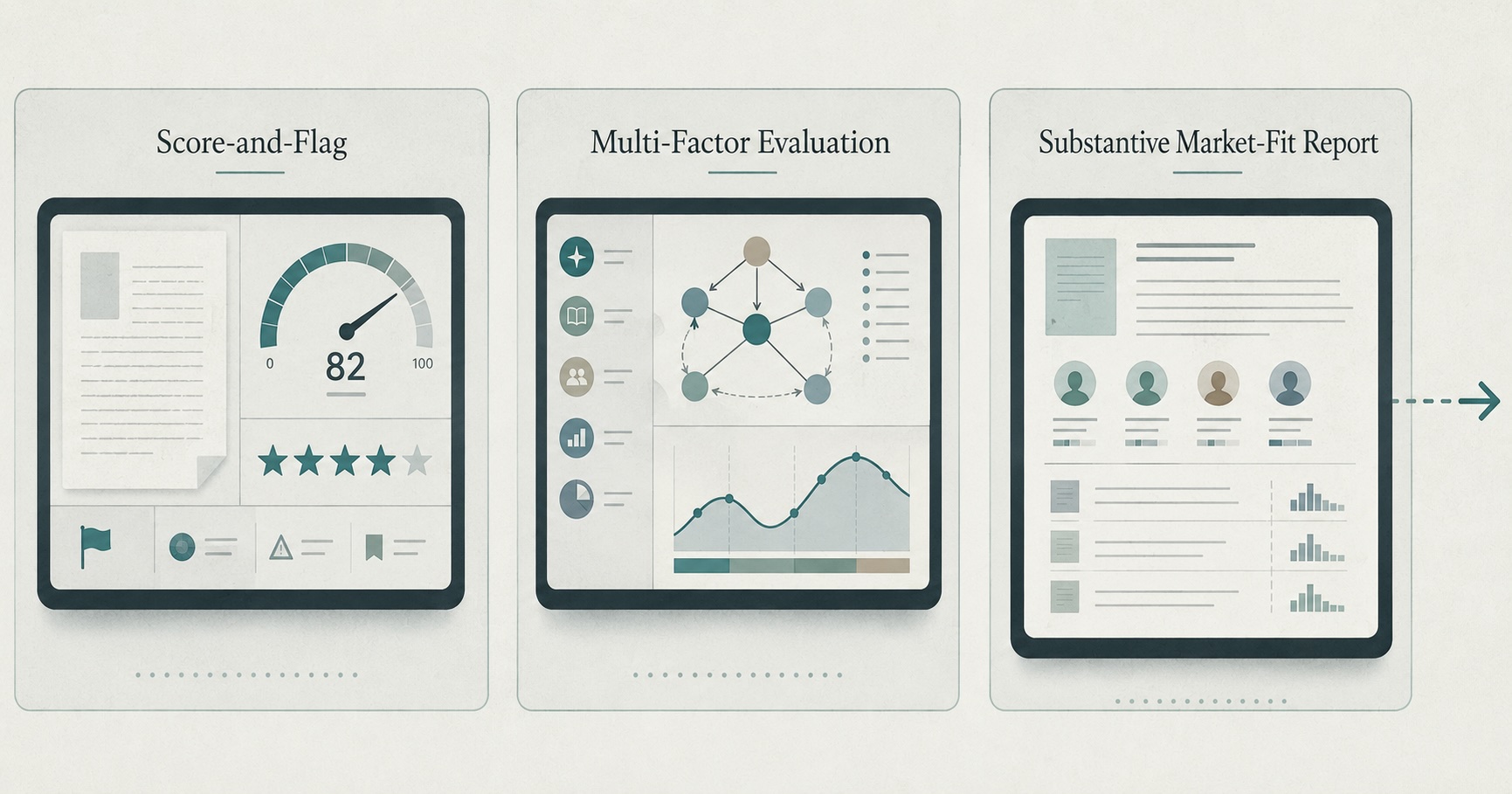
Three categories of AI-driven acquisitions tooling are now in trade-publishing production, each addressing a different decision point at the acquisitions stage.
Subscribe & Get Your Free Marketing Plan Template
Receive regular updates on marketing best-practices, AI shortcuts, and get our proven 4-phase marketing roadmap for free.
Score-and-flag triage tools
Trilogy Manuscript AI, launched January 5, 2026, is the most institutionally significant entrant. Trilogy claims a Sales Potential score (0–100) against twenty years of bestseller data, a Predicted Rating (1–5 stars) drawn from Amazon and Goodreads patterns, plus Genre Fit, Style Fit, and an Overall Score. Per Trilogy's marketing, the model is trained on a 2.7-million-book corpus of copyright-cleared and public-domain titles, Switzerland-hosted, and integrates with Trilogy's existing Title Management platform or runs standalone. Verifying those training-set claims against an independent source isn't currently possible — they're vendor disclosures, not third-party audited.
The positioning is explicit. Managing Director Alex Dare to Publishers Weekly:
"Our focus is basically the slush pile — the 94% to 97% of manuscripts that never get published."
That's the use case: numeric ranking output for editors triaging hundreds of submissions a month who need a fast first cut before allocating reader time. The score isn't a forecast — it's a relative ranking against the training set. Editors using these well treat the number as a "should we spend two more weeks of editorial time on this submission" signal, not a "should we acquire" signal.
Storywise plays the same shape at a different price point — extracts genre, word count, quality signals, plot structure, marketability, plus profiles the author's existing social and web presence, then matches against publisher-specific "taste profiles" trained on the imprint's historical acquisitions. The taste-profile approach is the closest current attempt at list-fit modeling: train on what an imprint has already acquired, then score new submissions against that pattern. Results are early; the use case is real. Mid-sized indie publishers with strong editorial identities — Berrett-Koehler, Graywolf, Tin House — have the cleanest training data for this kind of work.
Storywise doesn't publish pricing. Reported contracts at small-to-mid-sized publishers run in the $500–$1,000/month range, working out to roughly $2 per manuscript at typical slush load — but this is anecdotal reporting from publishers, not a vendor disclosure; verify with Storywise directly before budgeting. Named customers include Bloodhound Books and Collective Ink.
Multi-factor evaluation tools
Familiar offers a more analytical output: overall score plus character analysis with relationship mapping and development arcs, pacing assessment, plot structure, promise-fulfillment checking, and AI detection with confidence scoring. Pricing is published — $49 per book for editorial tools, or a credit-based system at $5 per credit — sitting between Storywise's per-manuscript scoring and a full editorial reader's report.
Substantive market-fit reports
ManuscriptReport's Book Marketing Report is positioned for the acquisitions decisions where a score-and-flag output isn't enough — where the question isn't "should we read further" but "if we acquire this, what does the market position look like." Seven of its twenty report sections map directly to acquisition-stage decisions: 10 comp titles with X-meets-Y reasoning, full synopsis, back-cover blurb draft, target audience personas with platform-specific targeting, genres and subgenres, BISAC codes for shelf placement, and themes for editorial-pipeline matching. Unlike the score-and-flag tools, the same report continues into post-acquisition production — the comp set used to evaluate the title becomes the ad-copy comp set, the audience persona becomes the Meta Ads target.
What hasn't shipped
Notably absent from the AI-triage product category: Submittable, the dominant submission management platform in indie and small-press publishing. Its public reviewing-features page lists no AI screening, scoring, or triage functionality as of mid-2026. Moksha (the Clarkesworld / F&SF / Lightspeed backend) has none. QueryTracker and Reedsy haven't added AI evaluation either. The gap between "submission management software" and "AI-driven submission evaluation" remains a category boundary — which means the workflow leak (staff privately copy-pasting manuscripts into consumer ChatGPT) is the operational reality at any publisher that hasn't adopted one of the named vendors.
How AI Plugs Into an Editor's Day
AI doesn't replace the acquisitions decision. It compresses two specific first-draft tasks that previously bottlenecked on reader time.
First-read triage and reader's-report drafting
An acquisitions editor's first read on a manuscript typically produces a reader's report: a short document covering plot summary, genre and category, comp titles, market positioning, prose quality assessment, and a recommendation. AI compresses the first three to five sections from forty-five minutes of reader time to two minutes of generation plus an editorial pass.
The output isn't a finished reader's report — it's a structured first draft the acquiring editor refines, contextualizes against the imprint's list, and uses to brief the acquisitions board. The teams using this well don't ship the AI output; they ship the editor's annotated and corrected version. The compression matters because it reroutes editor time from typing toward the work that requires judgment: list-fit calls, advance-level argument with the editorial director, comp negotiations with the agent.
Acquisitions meeting deck preparation
The acquisitions meeting deck — pitch summary, comp set, audience read, P&L assumptions, marketing positioning — is where AI's compression effect is most visible. The same source material (manuscript + agent letter) feeds five or six asset types that previously required separate research passes. A 90-minute deck-prep task compresses to a 15-minute AI generation plus a 30-minute editorial pass.
The trade-off worth naming: the AI deck draft tends to overweight comparable-title parallels and underweight editorial identity. Editors who use these tools well rewrite the positioning section and the P&L assumptions by hand; the comp set and audience read are the sections where AI saves the most time without trading off judgment. Deck prep on a manuscript heading to auction or anchoring a preempt compresses differently than slush — the comp work has to defend the offer against competing bidders, not just qualify the title for a fuller read.
Manuscript Analysis with General LLMs: Why ChatGPT Fails for Comp Titles
Comp titles are the single AI-acquisitions task editors most often attempt themselves with ChatGPT or Claude — and the single task where general-purpose LLMs most reliably fail. Jane Friedman's piece on the ChatGPT comp-title workflow (by John Matthew Fox, last updated February 2025) documents five recurring failure modes:
- Outright fabrication. ChatGPT generates plausible-sounding books that don't exist. In some cases the model self-flags the invention as "hypothetical" in the output; in many, it doesn't.
- Stale data. Free-tier ChatGPT models trained pre-2023 return comps from 2018–2021 even when asked for last-three-years titles. Agents and acquisitions editors specifically want recent comps as evidence of current market appetite; old comps signal author or model laziness.
- Ignored exclusion rules. Asked to exclude mega-bestsellers, models routinely include them anyway — Patterson, King, Hannah, Coelho appear in genre comp lists where they're useless as positioning anchors.
- Wrong author attribution. Real titles paired with the wrong author, or real authors paired with books they didn't write. This is the failure mode that most reliably damages credibility when surfaced in a query letter or acquisitions deck.
- Genre drift. Asked for cozy mystery comps, models return thrillers; asked for upmarket women's fiction, they return romance. The genre fingerprint isn't legible enough in the prompt for the model to constrain reliably.
Friedman's recommended workaround — "you'll need to do research on each suggested title. Make sure they exist" — is honest but defeats the purpose. The underlying problem is that general LLMs lack a recency-grounded book index; they're generating from training-data patterns rather than retrieving from a current corpus.
For comp work at acquisition, the editor's task is verification, not generation. The agent's comps in the pitch letter anchor the publisher's market-fit hypothesis; bad comps produce bad P&L models. AI extraction of additional comp candidates from the manuscript itself — themes, audience, narrative structure, voice — gives editors a check against agent positioning, particularly for debuts where the agent's market read may be optimistic. The question is never "what could plausibly be a comp" but "is this real, recent, and saleable."
Purpose-built tools address the hallucination problem by grounding generation against retrieved sources: Goodreads, Amazon catalog, publisher-side Edelweiss feeds, BookScan where licensed. ManuscriptReport's free pre-2020 comp-title research tool is positioned for author-side education and is intentionally limited to pre-2020 titles; for current acquisitions-grade comps, the paid Book Marketing Report or one of the publisher-tier tools (Trilogy, Storywise, Familiar) is the appropriate channel.
Where ManuscriptReport Fits at the Acquisition Stage
ManuscriptReport's positioning at acquisitions is distinct from the score-and-flag tools (Trilogy, Storywise) and the multi-factor evaluation tools (Familiar). Seven of the twenty Book Marketing Report sections — comp titles with X-meets-Y reasoning, full synopsis, blurb draft, audience personas, genres and subgenres, BISAC codes, themes for editorial pipeline — produce substantive market-fit analysis, not a numeric ranking.
The trade-off is intentional. Score-and-flag tools answer "should we spend more editorial time on this submission?" with a number. ManuscriptReport answers "if we acquire this, what's the market position, who's the audience, where does it shelve?" with a structured analytical report. Different questions, different shapes, both useful at different points in the acquisitions decision.
The structural advantage no other tool in the acquisitions category offers: the same report continues into post-acquisition production workflow. The comp set used to evaluate the title becomes the comp set for ad copy. The audience persona that anchored the list-fit decision becomes the targeting export for Meta Ads. Triage and production are the same artifact — not two separate vendors, two separate workflows, two separate manuscripts uploaded to two different systems.
Privacy and IP handling at publisher tier are contractual: manuscripts are never used for model training, are permanently deleted after a 30-day retention period, and outputs are owned by the uploading account. Pricing is configured against acquisitions volume and report mix — contact us for a configured estimate on your slush volume.
Evaluating AI for your acquisitions workflow? Request a publisher sample → — we'll run a configured snapshot on one of your own slush titles. No commitment, no setup call required.
Agent Contracts, Author Disclosure, and AI in the Loop
The under-discussed layer beneath the vendor decision is the contract layer. When a publisher runs an acquired (or pre-acquired) manuscript through an AI tool, three contractual questions are now in play that weren't in 2023:
What does the agent contract say? Most pre-2024 agent contracts are silent on AI processing of the submitted manuscript. Agents at the BISG panel and in subsequent industry commentary have raised the question of whether AI-scoring an unsold submission constitutes a use the agent and author authorized. The Authors Guild's April 2026 model contract clauses now require written author permission before uploading a manuscript to consumer AI tools and explicit opt-out from any AI training use. Whether those clauses cover publisher-side AI scoring at acquisition — as distinct from editing or training — is still being argued in contract renewals.
What disclosure is owed to the author when their manuscript is being scored? The Authors Guild's position is that authors must disclose AI use above a de minimis threshold (typically 5%) in submissions; the symmetrical question — must publishers disclose to authors that their submission was AI-scored before the acquisitions decision — has no settled industry answer. Vendor pitch materials are silent on it. Editorial directors evaluating tooling are advised to make the disclosure decision proactively, with counsel, before adopting a tool, not after a contested rejection.
What about audit trail and discovery risk? If a publisher acquires a manuscript on the basis of an AI score and the book underperforms, the AI evaluation is potentially discoverable in any subsequent litigation — author-side suits over imprint-fit obligations, agent-side suits over manuscript handling, even option-clause disputes. Publishers running internal AI pilots should treat the score outputs as records subject to litigation hold from day one, retained or deleted on a documented schedule. "We let the editor try ChatGPT" is the worst version of this — no audit trail, no retention policy, no defensible workflow.
The operational implication: a vendor relationship with explicit data-handling contract terms isn't just IP hygiene. It's the workflow layer that makes the AI-acquisitions decision defensible to authors, agents, and counsel later.
Frequently Asked Questions
What's the difference between rule-based publishing workflows and AI-driven publishing systems?
Rule-based publishing workflows — Klopotek, Firebrand, Title Management, Biblio — automate deterministic tasks: ISBN assignment, ONIX metadata distribution, royalty calculations, title-list ingestion, rights tracking. AI-driven systems automate generative and classification tasks: extracting comp titles from a manuscript, scoring sales potential, drafting reader's reports, predicting genre fit.
In practice the two coexist. The catalog of record stays in the rule-based system; AI handles the generative and analytical layer that previously required a marketer or first reader to type from scratch. Most publishers in 2026 run a hybrid — and AI at acquisitions sits beside the rule-based catalog, not inside it. (Fuller treatment in the post-acquisition production workflow guide.)
Are uploaded manuscripts safe from AI training and IP leakage when used for acquisitions evaluation?
On publisher-tier vendors with contractual data handling, yes — uploaded files never train any model and are permanently deleted after a defined retention period (30 days at ManuscriptReport; verify each vendor's specific terms). The architecture is different from passing a manuscript through a consumer ChatGPT or Claude account, where retention and training-use depend on the account tier and aren't governed by a publisher contract.
The most important risk in 2026 isn't vendor breach — it's the workflow leak. The Authors Guild's April 2026 statement specifically flagged editors privately uploading manuscripts and author PII to consumer AI tools "due to individual time pressures rather than official publisher directives." Closing that leak requires a vendor relationship the staff is actually allowed to use, not just a policy banning ChatGPT.
Will AI replace acquisitions editors?
No. AI compresses the first-draft layer of acquisitions work — synopsis generation, comp extraction, audience reads, market-fit scoring — but cannot replace the editorial judgment that determines whether a book belongs on a specific list. The Authors Guild's April 2026 position is unambiguous: AI should not make the acquisitions decision, only compress the research and drafting that informs it.
The publishers using AI well at acquisitions treat the output as a strong first draft and route editorial time to the work that actually requires judgment: comp negotiations, foreign rights pitches, author conversations, list strategy. The first-draft compression buys hours; editors spend those hours on the calls that matter.
How do we handle bias in algorithmic submission triage?
Sales-potential and genre-fit models are trained on historical bestseller and Goodreads data, which encodes the demographic and stylistic patterns of past bestsellers — patterns that may penalize voice-driven, debut, or underrepresented submissions in favor of pattern-matched commercial fiction.
The mitigation is procedural, not technical: don't use AI triage as a gating filter. Use it as one input in a process that includes human first-read on submissions the model scores low. The teams using these tools defensibly are running AI triage alongside traditional reading, not replacing it. The point isn't to filter out 80% of slush before any human reads it — it's to surface the 5–10% the model flags as high-potential earlier in the queue.
How does AI-driven acquisitions tooling fit with existing rule-based catalog systems like Klopotek?
It sits beside the catalog system, not inside it. The catalog of record — title-list management, ISBN assignment, ONIX distribution, royalty tracking — stays in Klopotek, Firebrand, Title Management, or Biblio. AI tooling handles the generative work at acquisition (reader's reports, comp research, market-fit analysis) and the metadata-extraction layer post-acquisition (categories, keywords, themes). Outputs feed back into the catalog system through standard imports.
Most publishers running both don't experience integration as a technical problem — it's an organizational one. The acquisitions team and the metadata team need to agree on which fields the AI generates, which fields the catalog system owns, and where the editorial validation step lives.
What does the Authors Guild's April 2026 position mean for publishers using AI in editorial?
The Authors Guild's April 2026 statement is the most consequential industry guidance on the topic to date. Key positions: publishers should not use AI to edit manuscripts beyond basic spell/grammar checks; staff uploading manuscripts or author PII to consumer AI without permission and without training opt-outs is unacceptable; model contract clauses now require written author permission before uploading work to consumer AI; authors must disclose AI-generated content above a de minimis threshold in submitted manuscripts.
For acquisitions specifically, the relevant guidance is that publishers should use AI vendors with contractual training and retention controls — not consumer ChatGPT — and that editors using AI tools should have explicit policy authorization for the use cases they're applying it to. The Guild's framing of "individual time pressures rather than official publisher directives" identifies the operational risk: the workflow leak, not the vendor adoption.
Where the Field Is Now
The trade-publishing answer to "what about AI in acquisitions" is no longer "we're experimenting." It's segmenting. High-throughput slush-volume tools (Trilogy, Storywise) for publishers triaging hundreds of submissions per month who need fast numeric rankings. Multi-factor evaluation tools (Familiar) for editors who need analytical depth on smaller submission queues. Substantive market-fit reports (ManuscriptReport) for editors evaluating titles already short-listed for the acquisitions meeting who want to know what the marketing position looks like before committing.
The publishers shipping AI badly at acquisitions are the ones using consumer chat tools without disclosure, treating the algorithmic score as the decision, or skipping the editorial pass. The publishers shipping it well are the ones using purpose-built tooling with contractual data controls, treating AI output as a first draft, and routing the time saved into the editorial work that actually requires judgment.
If you're evaluating where AI fits in your acquisitions workflow — and want to see what a publisher-tier acquisition snapshot looks like on one of your own slush titles — request a free publisher sample →. No commitment, no setup call required.
About this guide: Last updated May 18, 2026. For questions about implementing AI in your acquisitions workflow, contact our team. For the production-side counterpart covering metadata, marketing, and author handoff after a title clears acquisition, see AI Integration in Publishing Workflows (2026 Playbook).
Turn your manuscript into a ready-to-market package
ManuscriptReport turns your full book into 20 launch-ready marketing assets — back-cover blurb, SEO keywords, comp titles, ad copy, and more.
Get Your Marketing Report →Enjoyed this article? Subscribe for more + get a free marketing roadmap template.
Receive regular updates on marketing best-practices, AI shortcuts, and get our proven 4-phase marketing roadmap template for free.