How to Promote My Book on Amazon: A Practical Guide

Your Amazon book page is your most valuable piece of real estate as an author. It's your digital storefront, your 24/7 salesperson, and the final hurdle a potential reader has to cross before clicking "Buy Now."
Before you even think about running ads or driving traffic, this page has to be absolutely irresistible. Pouring money into promoting a page that doesn't convert is like pouring water into a leaky bucket. Let's get that foundation right first.
Build a Book Page That Sells
Think of it this way: every other marketing effort you make, from a Facebook ad to a newsletter blast, points directly to this single page. If it fails to do its job, everything else was a waste of time and money.
This foundational work—getting your keywords, categories, and description just right—is where you’ll see the highest return.
Nail Your Keywords and Categories
Before a reader can buy your book, they have to find it. Keywords and categories are the secret map to discoverability on Amazon. Getting them right isn't about guesswork; it's about getting inside a reader's head.
What would someone actually type into that Amazon search bar? Get specific.
- Genre phrases: "slow burn fantasy romance," "military sci-fi with aliens," "cozy mystery with a baker."
- Trope-focused searches: "enemies to lovers," "found family trope," "magic academy."
- Non-fiction solutions: "how to start investing," "beginner's guide to container gardening."
These aren't just for the seven keyword slots KDP gives you. Weave your most important phrases naturally into your book's subtitle and the first few lines of your description.
For categories, think niche. Instead of just "Fiction > Romance," drill down deeper. Aim for something like "Fiction > Romance > Paranormal > Vampires." It's far easier to hit #1 in a smaller, more specific category, and that little orange "Bestseller" tag is powerful social proof.
Write a Book Description That Hooks Readers
You've got about three seconds to stop a scroller in their tracks. Your book description's job isn't to summarize the plot; its job is to sell the experience.
A great book description doesn't tell the reader what the book is about—it makes them feel what the book is about. It creates an emotional hook and asks a question that can only be answered by reading the book.
For fiction, a simple formula that works wonders is:
- The Hook: Start with a punchy, one-sentence question or a bold statement that sets the tone.
- The Character: Briefly introduce your protagonist and their ordinary world before it all goes wrong.
- The Catalyst: What's the event that kicks the story into gear and raises the stakes?
- The Conflict: Hint at the challenges and enemies they'll face, but don't give away the good stuff.
- The Cliffhanger: End with a final, tantalizing question that makes them desperate to know more.
Applying an effective ecommerce content strategy to your book page is a game-changer. It shifts your mindset from "author" to "marketer," which is exactly what you need to succeed.
Amazon Book Page Optimization Checklist
Before you launch your book or start any new promotion, run through this quick checklist. These are the non-negotiables for a page designed to convert visitors into readers.
| Element | Key Action | Why It Matters |
|---|---|---|
| Book Title & Subtitle | Include a primary keyword phrase in your subtitle if it feels natural. | This is prime real estate for SEO and immediately tells readers what your book is about. |
| Book Description | Start with a strong hook and use compelling, emotion-driven copy. Format with bolding and short paragraphs. | Grabs attention instantly and makes the text scannable, preventing readers from clicking away. |
| Keywords | Fill all seven KDP keyword slots with relevant, specific reader search terms (not single words). | This is how Amazon's algorithm connects your book to active shoppers searching for it. |
| Categories | Choose two specific, niche categories where you have a realistic chance of ranking high. | A "Bestseller" tag, even in a small category, boosts credibility and sales significantly. |
| A+ Content | Create visually appealing graphics and text modules to enhance your page. | Adds a professional polish, allows you to showcase series info, and can increase conversion rates. |
| Author Central Profile | Fully complete your profile with a professional headshot, bio, and blog feed. | Builds trust and allows readers to connect with you as an author, encouraging them to follow you. |
Getting these elements right before you drive traffic is the single most important step you can take.
Use A+ Content to Create a Visual Experience
Once you've published at least one book, Amazon unlocks a fantastic free tool called A+ Content. This lets you go beyond the standard text description and add beautifully designed images, comparison charts, and formatted text modules to your page.
It transforms a bland product listing into a rich, immersive sales pitch. This is your command center for making that happen:
This is where you can really set your book apart visually, showcase your author brand, and provide extra details that can tip a hesitant buyer over the edge.
Given that Amazon holds a staggering 67% of the U.S. ebook market, the audience is massive, but so is the competition. With the ebook market pulling in $271 million in the first quarter of 2026 alone, standing out is not optional. A well-optimized page is your key to competing effectively and capturing your slice of that market.
Use Amazon's Own Promotional Tools
Your book's page is polished, but don't stop there. Amazon gives you a powerful set of promotional tools right inside your KDP dashboard, and frankly, most authors completely ignore them. These aren't just random features; they are built specifically to create sales momentum, boost your book’s rank, and find new readers.
There's one catch: your book needs to be enrolled in KDP Select. This means giving Amazon exclusive digital rights for 90 days at a time. It’s a trade-off, for sure, but the promotional firepower you get in return can be a total game-changer, especially when you're launching a new book or trying to get the first in a series off the ground.
The Power of Free with a KDP Free Book Promotion
Subscribe & Get Your Free Marketing Plan Template
Receive regular updates on marketing best-practices, AI shortcuts, and get our proven 4-phase marketing roadmap for free.
I know, offering your book for free feels wrong. You worked hard on it! But a strategic free promotion is one of the quickest ways to get your book into the hands of thousands of potential new fans. For up to five days each KDP Select term, you can make your Kindle ebook completely free.
The goal isn't profit—it's visibility and volume. A good free run can rack up tens of thousands of downloads, shooting your book to the top of the free charts. This sudden burst of activity tells Amazon's algorithm, "Hey, people like this book!" That can lead to much better visibility when it switches back to paid.
This strategy is pure gold for a few specific scenarios:
- Launching a new series: This is the classic move for a reason. Hook readers with book one for free, and a good percentage will happily pay for the rest of the series.
- Reviving a backlist title: Got an older book that's not selling? A free promotion can breathe new life into it and introduce it to a whole new audience.
- Gathering early reviews: You can't get reviews without readers. A flood of downloads dramatically increases your chances of getting those crucial first ratings.
Just remember, you can't just set it and forget it. To really make a free run work, you have to tell people about it. Email your list, shout about it on social media, and submit your book to websites that feature free Kindle books.
Create Urgency with a Kindle Countdown Deal
If you're not ready to go completely free, the Kindle Countdown Deal is your best friend. This tool lets you run a limited-time discount where the price slowly ticks back up to its original list price over a period of up to seven days.
This creates a fantastic sense of urgency. A little timer actually appears on your book’s sales page, showing shoppers how much time is left to get the deal. That psychological nudge is incredibly effective at turning casual browsers into buyers.
Kindle Countdown Deals work best for books that already have a bit of traction and at least a handful of good reviews. When new readers see that social proof combined with a ticking clock on a discount, it's a powerful reason to click "Buy Now."
This is the perfect approach when you want to spike sales for an established book or give a new release a strong push up the paid bestseller charts.
Deciding Between Free Promos and Countdown Deals
So, which one should you choose? It all comes down to what you're trying to accomplish with that specific book right now.
| Promotional Tool | Best For | Primary Goal |
|---|---|---|
| KDP Free Book Promotion | First-in-series, gaining reviews, building an email list | Maximum visibility and reader acquisition |
| Kindle Countdown Deal | Established books with reviews, new releases | Driving paid sales and increasing bestseller rank |
Ultimately, both of these tools are designed to create a spike in activity that gets Amazon's algorithm to pay attention to your book. For a deeper dive into more tactics, this guide on how to promote your book is a great resource. You can also amplify the effects of any promotion by finding influencers directly on Amazon who can give your book a shout-out to their dedicated followers.
Run Profitable Amazon Ad Campaigns

So, you’ve polished your book page and played around with Amazon's free promotional tools. Now it's time to talk about the most direct way to get your book in front of motivated buyers: paid advertising.
Amazon Ads can seem intimidating, and yes, you can easily burn through money if you’re not careful. But with a smart approach, they are an incredibly potent tool for driving sales and, just as importantly, improving your book’s organic ranking.
The goal isn't just to spend money—it's to invest it. A profitable ad campaign does more than just sell a book. Every sale you make through an ad pings Amazon's algorithm, signaling that your book is relevant. This can boost your visibility in organic search results, creating a ripple effect that lasts long after you’ve paused the campaign.
Getting to Know the Main Ad Types
Amazon offers a few ad formats, but for most authors, the world revolves around Sponsored Products. These are the ads you see sprinkled throughout search results and on other book pages, and they look almost identical to organic listings.
- Sponsored Products: The bread and butter of Amazon book advertising. These are cost-per-click (CPC) ads where you target specific keywords or even other products (like a competitor’s book). If you're new to ads, this is where you start.
- Sponsored Brands: Got a series or at least three books to your name? These banner-style ads sit right at the top of search results and are fantastic for building author brand recognition.
- Lockscreen Ads: These ads show up on the lock screens of Kindle E-readers and Fire tablets. They can be great for reaching dedicated readers, but they usually require a bigger budget. I'd recommend getting comfortable with Sponsored Products first.
Mastering Sponsored Products is the name of the game. This is how you place your book right next to your biggest competitors or at the top of a search for "enemies to lovers sci-fi romance," catching a reader at the exact moment they're looking for their next read.
Building Your Ad Keyword Strategy
Let's be clear: your ad keyword strategy is not the same as your KDP keyword strategy. Those seven KDP keyword slots are for long-term, organic discovery. Your ad keywords are for actively hunting down buyers right now.
Start by thinking like a reader, not an author. What would they type into the search bar?
- Author Names: Target popular authors who write in your exact subgenre.
- Comparable Titles: Find books that are a direct match for yours in tone, tropes, and style.
- Genre Keywords: Get specific. Don't just target "fantasy." Go for "epic fantasy with dragons" or "cozy paranormal mystery."
Once you have a solid list, you'll set up campaigns using different match types. Broad match is fantastic for fishing for new keywords you might have missed, while exact match lets you zero in on the terms you already know convert well.
A huge mistake I see authors make is dumping hundreds of keywords into a single campaign. A much better approach is to create small, tightly themed campaigns. For instance, run one campaign just for author names, another for book titles, and a third for genre terms. This gives you far more control and much cleaner data to analyze.
Your Budget and the Metrics That Matter
The thought of spending money on ads can be nerve-wracking, but you are always in complete control. Start small. A daily budget of just $5 or $10 is plenty when you're starting out.
The golden rule? Be patient. Let your campaigns run for at least a week to gather enough data. Don't check your dashboard after six hours and panic-pause everything.
The single most important metric you need to understand is ACOS (Advertising Cost of Sale). This percentage simply shows you how much you spent on ads to get a sale.
The formula is simple: ACOS = (Ad Spend ÷ Ad Sales) x 100
Let's say you spent $5 on ads, which led to a $20 book sale. Your ACOS would be 25%. The goal is to keep your ACOS below your royalty rate. If you earn a 60% royalty on your ebook, any ACOS under 60% means you're making money. Most seasoned authors aim for an ACOS between 30% and 40% to ensure a healthy profit margin.
Even a small, targeted campaign can deliver a big punch. After running a short paid promotion for his book 'Last Outlaw,' author Lee Hall saw his sales leap from 56 to 77 copies. That 37.5% increase was enough to push his book into a top 10 category rank, proving how a little ad spend can kickstart a cycle of visibility and organic growth.
Advertising is just one piece of the puzzle. To see how it fits into a comprehensive launch plan, check out our complete guide on book marketing for self-published authors for more winning strategies.
Get More Reviews Without Breaking the Rules
Reviews are the social proof that fuels the entire Amazon machine. After your cover and description grab a reader's attention, the reviews are what seal the deal. They’re often the single biggest factor that turns a hesitant browser into a buyer.But let’s be honest, getting them can feel like an uphill battle.
The trick is to create a system—a sustainable, ethical way to encourage feedback without ever crossing Amazon’s strict lines. You're not looking for a one-time explosion of reviews. Instead, you want a steady stream that shows both shoppers and Amazon's algorithm that your book is alive and well.
Build Your Advance Reader Team
An Advance Reader Copy (ARC) team is your best friend for a powerful launch. This is simply a hand-picked group of your most loyal fans who get a free digital copy of your book before its release. In return, they agree to leave an honest review on or around launch day.
Where do you find these people? Look wherever you already connect with your readers. Your email list, a private Facebook group, or even your Instagram followers are all great places to start. Begin with your most engaged fans; the quality of your ARC readers is far more important than the sheer number.
To keep things organized and save yourself a ton of headaches, you might want to look at platforms built for this:
- Booksprout: This is a great tool for finding new reviewers and automating the whole process of sending ARCs and follow-up reminders.
- StoryOrigin: Fantastic for author collaboration, StoryOrigin also has powerful tools specifically for managing ARC distribution and review collection.
These services handle the tedious logistics so you can get back to writing.
Always remember Amazon's golden rule: You cannot require a review in exchange for a free book. You're providing a copy and requesting an honest review. The wording is subtle but absolutely critical for staying within their terms of service.
Master the Gentle Ask
Beyond your dedicated launch team, every single person who finishes your book is a potential reviewer. The key is to make it incredibly easy for them and to ask at the right moment.
The perfect place for this is in the back matter of your book, right after the story ends. A simple, polite note works wonders. I find it’s best to frame it as a favor that helps other readers find a book they'll love, just like they did.
Here's a simple template I've used:
Thank you so much for reading! If you enjoyed this book, would you consider leaving a brief, honest review on Amazon? Your feedback helps other readers find their next favorite story and means the world to authors like me.
This same friendly approach works perfectly in your email newsletter. Whenever you announce a new release, pop in a line asking your subscribers to leave a review once they're done reading.
Navigate Amazon's Strict Policies
Amazon guards the integrity of its review system fiercely. If you break their rules, even by accident, you can see your hard-earned reviews vanish or, in a worst-case scenario, have your account suspended. It's not worth the risk.
Here are the absolute must-knows:
- No friends or family: Amazon's algorithm is smarter than you think. It can and will detect relationships, and it will likely remove reviews from anyone it considers too close to you.
- No "quid pro quo": You can't offer payment, gift cards, or contest entries in exchange for a review. This is a direct and serious violation.
- No review swaps: Agreeing to a "you review my book, I'll review yours" deal with another author is strictly forbidden.
Building a solid base of reviews is a long-term game, just like every other part of your marketing. To see how this fits into the bigger picture, our guide on how to advertise your book provides a broader strategy for building sales momentum.
Ultimately, it comes down to two things: write a fantastic book, and then make it easy for your genuine fans to share their thoughts with the world.
Drive Targeted Traffic From Outside Amazon
Relying solely on Amazon's internal traffic is like fishing in a well-stocked pond. It's a great start, but the real ocean of readers is out there. Driving traffic from outside Amazon is one of the most powerful signals you can send to its algorithm, telling it that your book has a life and a following beyond the platform.
Of all the tools at your disposal, your author website and email list are your crown jewels. Why? Because you own them. Social media algorithms can change overnight, but your website and email list are direct lines of communication to your readers.
Build Your Author Platform
Think of your author platform as your digital home base. It's the central hub where new readers can discover you, loyal fans can get the latest news, and everyone is guided toward a single, clear goal: buying your book. A clean, professional author website isn't a luxury; it's essential.
Make sure your site includes these key elements:
- A Punchy Homepage: Your latest book needs to be front and center. Use a killer cover image and a big, obvious "Buy on Amazon" button. Don't make people hunt for it.
- A Relatable "About" Page: This is your chance to connect. Readers fall in love with authors, not just their books. Share your story, what drives you to write, and what makes you tick.
- An Email Signup Form: Place this everywhere. Offer a compelling reason for people to sign up, like a free short story, a deleted chapter, or a character prequel. This is often called a "reader magnet."
Your website is the hub, and your social media channels are the spokes leading back to it. Don't try to be everywhere at once. Pick one or two platforms where your ideal readers hang out. For instance, the #BookTok community on TikTok has become a publishing phenomenon, capable of making an old book a bestseller practically overnight.
Harness the Power of Your Email List
I can't stress this enough: an email list is the single best tool for guaranteeing a sales spike on launch day. These aren't just followers; they are your super-fans who have literally invited you into their inbox.
In the weeks leading up to a release, you can tease them with behind-the-scenes content, cover reveals, and juicy excerpts. When launch day arrives, a direct email to this group can trigger a concentrated burst of sales. That initial velocity is pure gold for climbing the Amazon charts.
Sending traffic from your own email list is like bringing your own cheering section to the game. It shows Amazon that an engaged audience already exists for your book, which can significantly influence its visibility in search results and "Also Bought" recommendations.
The impact of this external push is clear. When you drive clicks from outside sources, you can see a direct effect on your book page's performance.
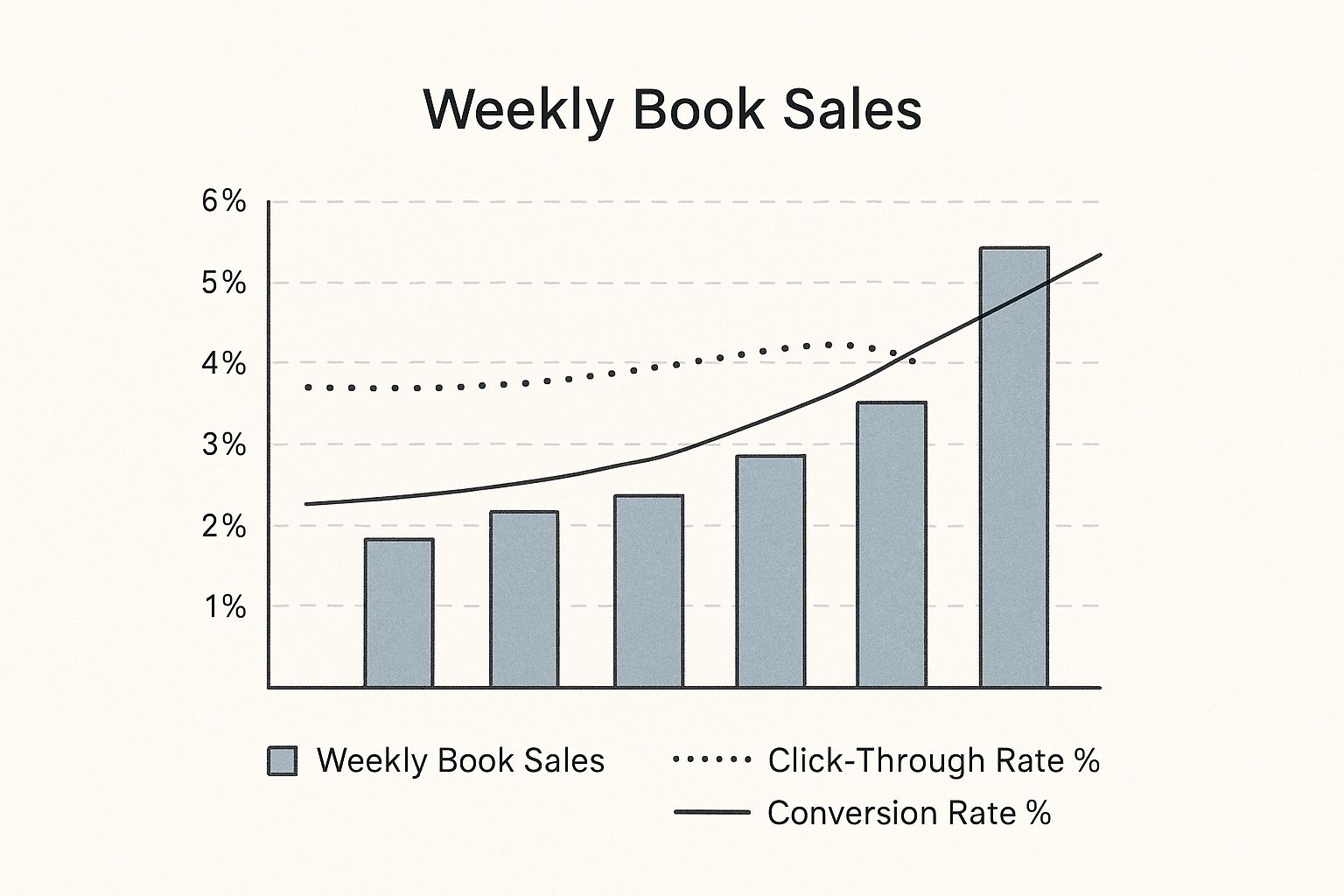
As you can see, a jump in external clicks often leads to better conversion rates and more sales, creating a cycle of success.
Collaborate With Influencers and Bloggers
Why build an audience from scratch when you can borrow one? Reaching out to book bloggers and influencers in your genre gives you a direct line to thousands of passionate readers who trust their recommendations.
Start by researching influencers whose followers would genuinely love your book. A personal touch goes a long way. When you reach out, explain why you think their specific audience is a perfect match. If you're really serious about building a community, you might even learn how to start a book blog yourself to become a trusted voice in your genre.
Finally, don't overlook paid promotional sites. Securing a BookBub Featured Deal, for example, can be a game-changer, driving tens of thousands of sales in a single day. It's competitive, but the ROI can be massive, often launching a book onto bestseller lists and giving it a long-term sales tail.
External Traffic Source Comparison
Choosing where to focus your external marketing efforts can feel overwhelming. The table below breaks down some of the most common traffic sources to help you decide where to invest your time and energy.
| Traffic Source | Best For | Effort Level | Potential Impact |
|---|---|---|---|
| Email List | Driving powerful launch day sales spikes and engaging your most loyal fans. | Medium | High |
| Author Blog/Website | Building long-term authority, capturing email signups, and creating a central hub. | High | High |
| TikTok (#BookTok) | Reaching younger audiences through viral, short-form video content. | Medium | Very High |
| Instagram (#Bookstagram) | Visually-driven marketing, connecting with reviewers, and cover reveals. | Medium | Medium |
| Facebook/Goodreads Groups | Engaging with niche communities and readers of specific subgenres. | Low-Medium | Medium |
| BookBub Featured Deal | Generating massive, short-term sales velocity for discounted ebooks. | Low (but hard to get) | Very High |
Ultimately, a mix of these strategies will yield the best results. Start with one or two that align with your book and your personal strengths, then expand as you gain momentum. Each new reader you bring to Amazon from the outside world strengthens your book's position on the platform.
Your Top Amazon Book Promotion Questions, Answered

Diving into Amazon book promotion can feel overwhelming. There's a lot of jargon and a ton of conflicting advice out there. So, let's clear things up and tackle the questions I hear most often from authors just like you.
Think of this as a straight-to-the-point chat. No fluff, just practical answers to help you build a promotion strategy that actually works.
How Much Should I Budget for Amazon Ads?
This is the big one, right? The good news is, you don't need a huge war chest to get started. I always tell authors to begin with a small, manageable daily budget—think $5 to $10 per campaign.
Your initial goal isn't to skyrocket up the charts overnight. It's all about gathering intelligence. You're trying to figure out which keywords actually lead to sales, what ad copy resonates with readers, and what your typical cost-per-click looks like. Once a campaign proves it's profitable (meaning your Advertising Cost of Sale, or ACoS, is lower than your royalty rate), that's when you can start confidently scaling up your spending.
Expert Tip: Treat your first ad dollars as an investment in data. Spending $100 to discover what doesn't work is just as valuable as finding a winning keyword. It can save you a fortune down the road.
Should I Enroll My Book in KDP Select?
Enrolling in KDP Select means giving Amazon exclusive rights to sell your ebook for 90-day terms. It’s a big decision, but the perks can be significant. You gain access to Kindle Countdown Deals and Free Book Promotions, and your book lands in the Kindle Unlimited (KU) library, where you get paid for every page read.
So, is it right for you? Here's how I break it down for authors:
- Go for KDP Select if: You write fiction, especially in a binge-worthy genre like romance, fantasy, or thrillers where readers devour books. It's also a fantastic tool for authors with a series, as KU readers are notorious for reading an entire catalog once they're hooked.
- Maybe go "wide" (skip KDP Select) if: You already have a dedicated readership on other platforms like Apple Books or Kobo. It can also be a better move for some non-fiction books that have strong sales potential across multiple retailers.
For most new authors, the visibility that comes from KU and the built-in promo tools make KDP Select a no-brainer, at least for the first 90 days.
How Long Does It Take to See Results?
I wish I could give you a magic number, but the truth is, book promotion is a marathon, not a sprint. Sure, a big push from a service like BookBub or a hot ad campaign can give you a nice, immediate sales spike. But real, lasting success comes from the slow and steady grind.
Amazon's algorithm rewards consistency. It's looking for a steady stream of sales and reviews over time.
As a rule of thumb, give any new marketing effort at least 30 to 60 days to see how it's really performing. For Amazon Ads, you'll want to let them run for at least a week before you touch anything. Be patient. The most successful authors I know are the ones who show up every day, tweaking their strategies and building their audience one reader at a time. The work you do today will keep paying off for months, and even years.
Ready to stop guessing and start selling? ManuscriptReport.com can turn your book into a complete marketing toolkit in just a few minutes. Imagine getting KDP keywords, ad copy, blurbs, and even social media posts, all generated directly from your manuscript. Spend less time on marketing and more on writing your next book. Visit https://manuscriptreport.com to get your report today.
Turn your manuscript into a ready-to-market package
ManuscriptReport turns your full book into 20 launch-ready marketing assets — back-cover blurb, SEO keywords, comp titles, ad copy, and more.
Get Your Marketing Report →Enjoyed this article? Subscribe for more + get a free marketing roadmap template.
Receive regular updates on marketing best-practices, AI shortcuts, and get our proven 4-phase marketing roadmap template for free.
Related Articles
Auto Generate Book Blurb AI Guide
Learn to use an auto generate book blurb AI to write compelling descriptions that sell. This guide offers actionable tips for authors and self-publishers.

Content Distribution Strategies to Boost Reach
Learn top content distribution strategies to increase your book's reach. Discover how to leverage media channels for maximum exposure.

How to Advertise Your Book: Proven Tips for Success
Learn how to advertise your book effectively with actionable strategies for Amazon, social media, and more. Start selling more today!