How to Get a Book Deal A Realistic Guide

Getting a book deal isn't about some magical stroke of luck. It’s a methodical process that starts long before you ever talk to a publisher. You need to perfect your manuscript, create a killer query letter and proposal, and then find the right literary agent to get you in the door. That agent is your advocate, your guide, and your partner in this whole venture.
Your Realistic Path to a Traditional Book Deal
The journey to getting published is a series of deliberate, well-planned steps. Think of it less like a lottery ticket and more like a professional project that demands creativity, strategy, and a whole lot of grit.
Many authors are essentially running a small business with themselves as the product, which is why applying project management principles for authors can make all the difference. It helps you move from just "being a writer" to being a professional who knows how to get from concept to contract.
Before we dive deep, let's get a high-level view of the road ahead. Landing a traditional book deal really comes down to successfully navigating four distinct stages.
The Four Core Stages to Securing a Book Deal
| Stage | Primary Goal | Key Action |
|---|---|---|
| Stage 1: Preparation | Polish your manuscript to a professional standard. | Writing, revising, and getting feedback until the book is truly ready. |
| Stage 2: The Pitch | Create compelling materials that sell your book. | Crafting a perfect query letter and a comprehensive book proposal. |
| Stage 3: Agent Quest | Secure representation from a literary agent. | Researching agents, sending personalized queries, and handling rejections. |
| Stage 4: Submission | Get an offer from a traditional publisher. | Your agent pitches your manuscript to editors at publishing houses. |
Mastering each of these stages is what separates the hopefuls from the published authors. There are no shortcuts.
The Agent Is Your Gateway
For nearly every writer dreaming of a deal with a major publisher, the path leads directly through a literary agent. They are the gatekeepers of the industry and your single most important champion. Grasping their role is the first real step to understanding how this business works.
An agent's belief in your work is the first major validation you'll get in the publishing world. They're investing their time, contacts, and reputation in you, which is why they have to be so selective.
This whole process follows a very specific sequence.
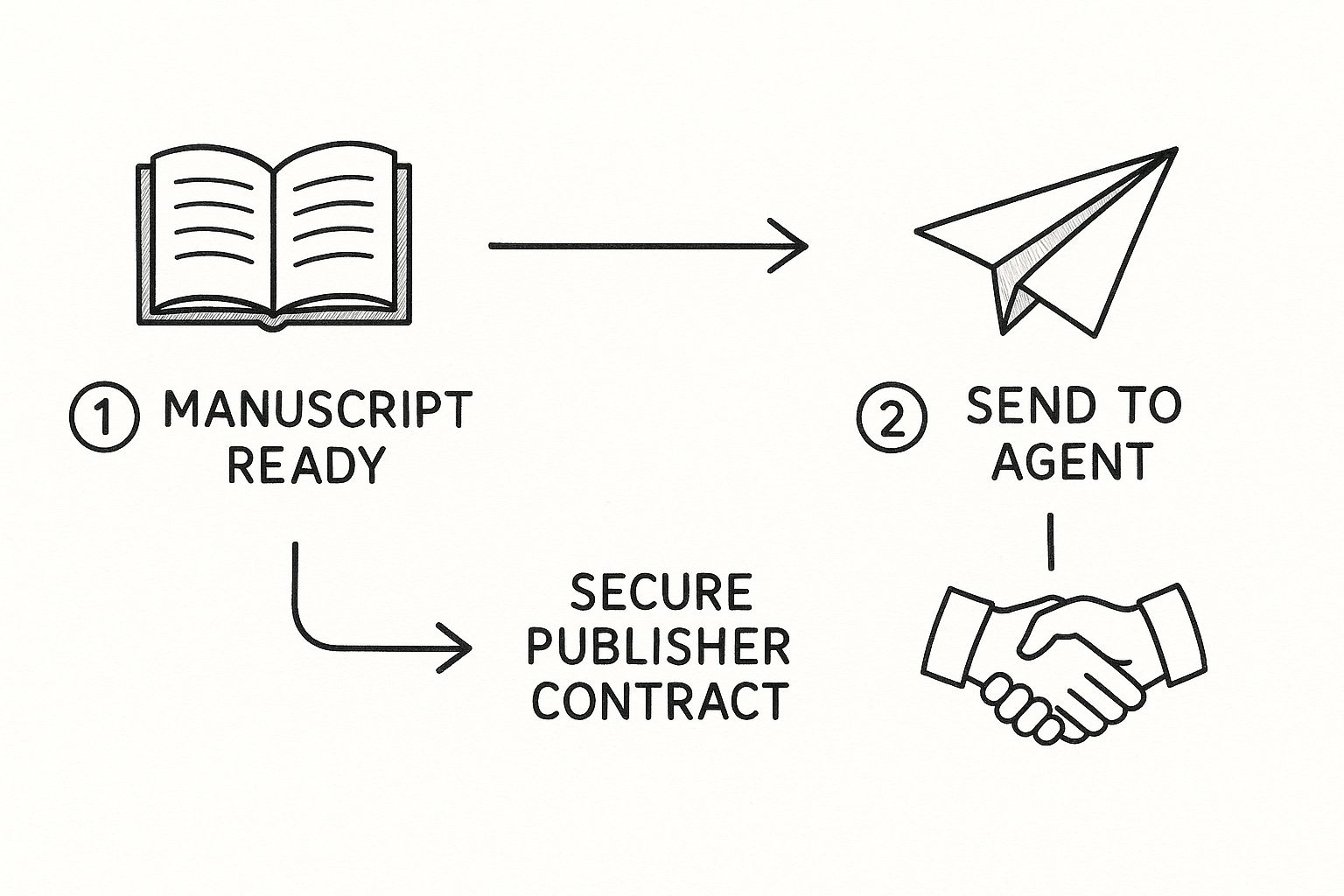
As you can see, it all starts with your book. A polished manuscript is the price of entry. The agent is the key that unlocks the door. The publisher is the destination.
Navigating the Odds
Let’s be honest: this is a competitive field. That’s precisely why a smart, strategic approach is non-negotiable.
The numbers can seem daunting, but they just reinforce the need for preparation. Only about 10% of manuscripts sent to agents even get an offer of representation. Once you have an agent on your side, they'll submit your work to publishers. But publishers only acquire 1-2% of the manuscripts that cross their desks, which is why that agent partnership is so critical.
This system isn't meant to be discouraging; it's designed to filter for quality and commercial potential. The authors who succeed are the ones who show up ready to play.
Getting Your Manuscript and Proposal Ready for Prime Time
Before an agent ever sees your work, it needs to be more than just a good idea. It has to be bulletproof. A killer concept won't get you a book deal on its own; your execution has to be professional, polished, and ready to compete in the market. This is where you shift from being just a writer to becoming a strategic author.
Professional agents notice well-organized manuscripts. Using robust writing software helps you present your work professionally from day one. Check out our guide to Scrivener alternatives for tools that help you organize and format manuscripts to industry standards.
Many writers new to the game tend to lump all "editing" into one big bucket, but that's a mistake. There are distinct layers to the editing process, and knowing the difference is crucial. Each stage strengthens your manuscript in a very specific way, from its foundational structure right down to the last comma.
The Three Layers of a Polished Manuscript
Think of editing like building a house. You can't start painting the walls if the foundation is cracked and the framing is crooked. The same logic applies to your book.
Developmental Editing: This is the big-picture, architectural work. A developmental editor examines the very bones of your story—plot, character arcs, pacing, and overall structure. They're the ones who ask the tough questions, like, "Does this story actually hold together?"
Copyediting: With a solid structure in place, the copyeditor comes in to work on the sentence level. They're your expert for grammar, syntax, and punctuation, ensuring your style and tone are consistent from chapter to chapter.
Subscribe & Get Your Free Marketing Plan Template
Receive regular updates on marketing best-practices, AI shortcuts, and get our proven 4-phase marketing roadmap for free.
- Proofreading: This is the final walkthrough. The last coat of paint. A proofreader is your fresh set of eyes, catching any typos, formatting glitches, or stray errors that slipped through the cracks. It's the final quality check before you send it out into the world.
Beyond the pros, you absolutely need feedback from real readers. This is where beta readers are worth their weight in gold. These are people in your target audience who can tell you what’s working and what isn’t from a genuine reader's perspective. They’ll spot confusing plot points or tell you when a character just isn't landing—insights you're often too close to see yourself.
How to Craft a Non-Fiction Book Proposal That Sells
If you're a non-fiction author, your book proposal is everything. In many cases, it’s even more important than the finished manuscript. Think of it as the business plan for your book, designed to convince an agent and a publisher that your project is a smart investment.
A winning proposal has to be airtight. It needs to present a comprehensive case for your book, leaving no questions in the publisher's mind.
As you can see, a solid proposal moves logically from the hook to the nitty-gritty details, proving both the book's creative merit and its potential to sell.
Your proposal needs to nail three things:
- A Killer Overview: This is your hook. It has to grab the reader immediately, explaining the core idea, why this book needs to exist right now, and exactly who will be buying it.
- Detailed Chapter Summaries: Think of this as the book's roadmap. Each summary should briefly outline the chapter's content and, crucially, explain the value and takeaways for the reader. What will they learn or experience?
- A Smart Market Analysis: This is where you prove there's an audience hungry for your book. You'll identify a few competing titles (and clearly explain how your book is different and better) and detail your author platform—your proven ability to reach readers.
Your proposal’s main job is to remove risk for the publisher. It needs to send a clear message: "This author has a sharp vision, knows their audience, and has the platform to make this book a success."
Of course, none of this matters if the writing itself isn't strong. It's always a good idea to improve your writing skills continuously. A brilliantly polished proposal, backed by a professionally edited manuscript, is the one-two punch that makes agents sit up and take notice.
Finding and Querying Your Future Literary Agent

You’ve done the hard work. Your manuscript is polished, and your book proposal is ready to go. Now, it’s time to find a partner for the next stage of your journey: a literary agent.
Think of an agent as more than just a salesperson. They're your advocate, your career strategist, your tough-love editor, and your chief negotiator. Landing the right one is a huge step toward a book deal, but getting there requires a smart, targeted approach.
The biggest mistake I see authors make is the "spray and pray" method—blasting their query out to every agent they can find. That’s a fast track to a folder full of rejections. The real key is strategic research. You need to build a curated list of agents who are actively looking for a book just like yours.
Building Your Targeted Agent List
This research phase is all about finding agents with a proven track record in your specific corner of the market. If you've written a gritty sci-fi thriller, querying someone who specializes in cozy historical fiction is a waste of your time and theirs.
Here are the tools the pros use:
- Publishers Marketplace: This is the industry's home base. A membership is worth its weight in gold, as it lets you see who is selling what to whom. You can find out which agents are selling books like yours and which editors are buying them. It’s invaluable intel.
- QueryTracker: This is your organizational command center. It's a massive, searchable database of agents where you can filter by genre, see if they're open to submissions, and even read comments from other authors about their experiences and response times.
Using these resources, your first goal should be to build a list of 10-15 high-priority agents. For each name on that list, dig deeper. Who are their clients? What have they sold recently? Does your book feel like it would fit on their shelf? The answers will help you personalize every single pitch.
Crafting the Perfect Query Letter
Your query letter is your one-page sales pitch. It has to be sharp, professional, and so compelling that an agent feels they must read your manuscript. With hundreds of queries flooding their inboxes every week, yours has to grab them from the first sentence.
A great query letter doesn’t just describe your book; it captures its essence and voice. It makes the agent feel like they’ve already discovered something special before they’ve even read the first page.
The structure is pretty standard, but the execution is everything. Mastering this first impression is non-negotiable if you want a book deal.
Here's the breakdown:
- The Hook (Paragraph 1): Kick things off with a gripping, one-or-two-sentence pitch. Introduce your protagonist, their core conflict, and what’s at stake. Make it sound like the best back-cover copy you’ve ever read.
- The Mini-Synopsis (Paragraph 2): Briefly unpack the plot. Hit the key turning points and the main emotional arc, but don't get lost in the weeds with subplots. Keep it focused and punchy.
- The Author Bio (Paragraph 3): Now, a little about you. Mention any writing credentials, awards, or unique expertise that makes you the perfect person to tell this story. Keep it brief and relevant.
Getting this letter right is a critical skill. For examples and formatting guidance, check out our query letter format and sample guide.
And one final, crucial tip: always, always follow each agent's submission guidelines to the letter. Don't give them an easy reason to say no.
1. Figure Out Where Your Book Fits in the Market

Let's get one thing straight: publishing is a business. Yes, it’s about art and story, but before an agent or editor can fall in love with your manuscript, they have to see a viable path to selling it. This means you have to think like an acquisitions editor, and that requires a bit of homework on your end.
Understanding where your book fits into the current marketplace isn't just a nice-to-have; it's absolutely essential if you want to land a book deal.
The first step is to get a real sense of what's already on the shelves. You need to read—a lot—within your genre. Specifically, focus on books published in the last two to three years. As you read, pay attention. What are the common themes? Are there certain character archetypes or plot structures popping up over and over? This isn't about copying trends. It's about understanding the conversation your book is about to join.
The market itself is always shifting. While publishers still bank heavily on print formats (especially hardcovers) when deciding what to acquire, the explosion of audiobooks and e-books has changed the game. This opens up new revenue streams, but it also means your book has to prove it can compete across multiple formats.
Finding Your "Comp Titles"
One of the most powerful tools in your arsenal is the comparative title, or "comp title." Think of these as recently published, successful books that appeal to a similar audience as yours. They might share a tone, a theme, or a unique premise. Getting your comp titles right is how you signal your book's market position to an agent in an instant.
A word of caution: don't pick massive, runaway bestsellers or timeless classics. Saying your book is "the next Harry Potter" is a classic rookie mistake. You need to be much more strategic.
Here’s what makes for a strong comp title:
- They're recent: Aim for books published within the last 3-5 years. This shows you're in touch with the current market.
- They're specific: "A psychological thriller" is vague. "For fans of The Silent Patient's unreliable narrator, but set in the cutthroat academic world of The Secret History" is compelling. It paints a picture.
- They show viability: Good comps are proof that an audience already exists for a book like yours.
Comp titles are your shorthand for telling an agent, "People who bought and loved these specific books will buy and love my book, too." It’s an instant pitch that frames your project as a smart commercial bet.
Nailing this analysis is a skill, and it's one worth developing. If you need a deeper dive into finding and analyzing comparable titles, check out our practical guide on how to research comparable titles for your book.
Knowing Your Genre and What Readers Expect
Finally, you have to be crystal clear on your book's specific category and the promises it makes to the reader. A cozy mystery and a hardboiled noir operate under completely different sets of rules. A YA fantasy has to hit certain plot points and emotional beats that are totally different from an adult epic fantasy.
When you can speak fluently about these conventions, you signal to agents that you know your audience inside and out. It shows you've written a book that not only delivers on reader expectations but also brings something fresh and exciting to the table. This is how you position your manuscript not just as a great story, but as a product ready for its target market.
Navigating Submissions and Your First Book Contract
https://www.youtube.com/embed/z3U0FRb9yr4
So, you’ve signed with a literary agent. Congratulations! Now, take a deep breath, because the real waiting game is about to begin. This next stage is called being "on submission," and it's when your agent starts sending your manuscript out to a hand-picked list of editors at publishing houses.
It’s a bizarre mix of excitement and nail-biting anxiety. Honestly, the whole process can feel like a total black box. Your agent will usually submit in "rounds," starting with a small group of editors they believe are the perfect fit. Then you wait. The responses can be anything from a quick "no" to detailed feedback, or—the dream—a request to schedule a call.
Patience is everything at this stage. I'm not kidding. It's completely normal for a book to be on submission for months, so try not to check your email every thirty seconds.
Decoding Editorial Feedback
Rejections are just part of the game. You're going to get them. But not all rejections are created equal. A generic form letter doesn't tell you much, but personalized feedback? That's pure gold. It means an editor connected with your story enough to take the time to explain why it wasn't a perfect fit for them right now.
Sometimes, an editor will fall in love with your concept but think the manuscript isn't quite there yet. This can lead to what’s called a "Revise and Resubmit," or R&R. Getting an R&R request is a fantastic sign. It's an editor saying, "I'm this close to making an offer. Fix these things, and we can talk." It’s more work, for sure, but it also means you’re on the verge of a deal.
The submission process is a test of your resilience. Every piece of feedback, good or bad, is a lesson. Use it to better understand the market and sharpen your own writing.
The industry is also always shifting. With the explosion of self-publishing, publishers are keeping a close eye on successful indie authors. Some are even offering profit-sharing deals instead of big advances, opening up new avenues for writers. If you can prove there's already an audience for your work, it can make you a much more attractive prospect to a traditional publisher.
The Offer and The Contract
When an offer finally lands, your agent will call you immediately. If you're lucky enough to get interest from more than one publisher, your agent might even set up an auction to drive up the advance and get you the best possible terms.
Once you accept an offer, the contract negotiation starts. This legal document is the blueprint for your entire relationship with the publisher, so it’s critical to understand what you're signing.
Here are the key pieces you’ll need to get familiar with:
- The Advance: This is money the publisher pays you upfront, which is then earned back against your future royalties. It's usually split into payments—one chunk on signing, another when you deliver the final manuscript, and a final one when the book is published.
- Royalty Rates: This is the percentage you get from each book sale. The rates are different for hardcover, paperback, and e-books. Many contracts include escalator clauses, meaning your royalty percentage goes up after you sell a certain number of copies.
- Subsidiary Rights: This bucket covers all the other ways your book can make money—think audiobooks, film and TV rights, and foreign translations. Your agent will fight to keep as many of these for you as possible.
Seeing your first book contract can be intimidating, filled with dense legal language. It’s worth learning how to read contracts so you can walk into the conversation feeling empowered. But remember, your agent is your expert and your champion. Lean on them, ask a million questions, and make sure the final deal is one that sets you up for a long, successful career.
Common Questions About Getting a Book Deal
The road to a book deal can feel like a maze. It’s a world that often seems to operate on unwritten rules and timelines that stretch into eternity. I've heard the same handful of questions from aspiring authors over and over again, so let's clear the air on some of the most common ones.
How Much Does It Cost to Get a Book Deal?
This is the big one, and the answer is simple: you should never pay a legitimate literary agent or traditional publisher. Ever.
Think of it this way: their success is directly tied to yours. A literary agent only makes money after they sell your book to a publisher. Their commission, which is the industry standard of 15% for domestic sales, comes out of the advance the publisher pays you. If you don't get paid, they don't get paid.
The real costs are the investments you make in yourself and your manuscript. This is money you spend to make your work undeniable. We're talking about things like:
- Hiring a professional editor to get your manuscript into fighting shape.
- Attending writing workshops or conferences to hone your craft.
- Subscribing to essential industry tools like Publishers Marketplace.
These aren't fees to get a deal; they're investments to make your book competitive.
Do I Need a Social Media Following?
Ah, the platform question. The answer really depends on what you're writing.
For non-fiction, a strong platform is pretty much non-negotiable. If you're writing a book on a specific topic, publishers need to see proof that you have a built-in audience—a blog, a popular social media presence, a solid email list—that's already eager to hear what you have to say.
For fiction, it’s a bit different. A phenomenal story is still the most important thing. A breathtaking manuscript will always find a home. But let's be realistic: if an editor is on the fence between two great novels, and one author has 20,000 engaged followers on Instagram while the other has none, that can absolutely be the tie-breaker. The manuscript always comes first, but a platform is a powerful tool in your corner.
Your author platform signals to publishers that you're not just a writer; you're a partner in the book's success. It shows you're ready and able to help market your work from day one.
Starting to build that audience now is one of the smartest things you can do for your career. If you're not sure where to begin, our guide on how to market a book lays out some practical first steps.
How Long Does It Typically Take?
If there's one virtue every author needs, it's patience. The publishing timeline is notoriously slow, and it's almost always longer than you think it will be.
Just finding an agent can easily take months, and for many, it can stretch into a year or more of querying. Once you finally sign with that perfect agent, they'll put your book on submission to editors, a process that can take another six months to well over a year.
All in all, from the day you send your first query letter to the day your book actually lands on a bookstore shelf, you're often looking at a minimum of two to three years. It’s a marathon, not a sprint. The ones who make it are the ones who treat it like a profession and refuse to give up.
Ready to turn your manuscript into a powerful marketing asset? ManuscriptReport.com generates a complete book marketing report in minutes, giving you the blurbs, keywords, comp titles, and ad copy you need to impress agents and publishers. Stop guessing and start selling.
Turn your manuscript into a ready-to-market package
ManuscriptReport turns your full book into 20 launch-ready marketing assets — back-cover blurb, SEO keywords, comp titles, ad copy, and more.
Get Your Marketing Report →Enjoyed this article? Subscribe for more + get a free marketing roadmap template.
Receive regular updates on marketing best-practices, AI shortcuts, and get our proven 4-phase marketing roadmap template for free.